
Three of the most credible elk hunters alive disagree about this. They’re all right — they’re just describing different windows. Here’s how to tell which one you’re standing in.
Every September somebody declares that calling elk on public land is finished — that the bulls have heard it all, that the woods are full of guys with diaphragms, that the only way to kill a pressured bull is to shut up and still-hunt him. I’ve guided Colorado’s Rockies for seven years, 50-plus days a season, and I can tell you the honest version: calling isn’t dead. Calling from 300 yards is dead. Those are not the same problem, and confusing them is why most hunters have decided the tactic doesn’t work.
The short version: Bulls on pressured public land still respond to calls. What they’ve mostly stopped doing is walking a long way to investigate one. The system that works for us is a two-stage move — a locate bugle to find him, then close to 50 to 100 yards before a single cow call leaves your mouth. Early season leans on cow calls. Peak rut lets you get aggressive. And there’s one situation where the right call is no call at all.
The argument over calling elk on public land has gotten religious, which is a shame, because the people worth listening to don’t actually agree — and the shape of their disagreement is more useful than any one of their answers.
The Experts Don’t Agree, And That’s The Point
Look at where three of the most respected voices in elk hunting land on this.
Paul “ElkNut” Medel argues that unresponsive elk are still callable — that when it isn’t working, the problem is usually the hunter’s read of the situation rather than the animal’s willingness. He and his son have taken more than 60 public land bulls on over-the-counter tags, so that’s not theory.
Remi Warren sits at the aggressive end. He’s built a career on unapologetic bugling and considers it his highest-percentage tactic. He’s also the guy who’ll climb into a wallow and splash around like he’s taking the place over — bulls come to inspect that without ever making a sound.
Dan Staton of ElkShape pulls the other direction. His position is that the bigger bulls tend to come when you put the calls away and sneak in, because elk in pressured country have heard every call in the book from roads and ridges. He also points out that satellite bulls stay responsive in high-pressure areas even when the herd bulls have gone quiet.
Medel says read better. Warren says push harder. Staton says shut up and sneak. Here’s the thing — I’ve watched all three of those be the correct answer, sometimes in the same week. The variable isn’t who’s right. It’s pressure, distance, and where you are in the month.
The Poison Dart: Bugle To Find Him, Cow Call To Kill Him
This is the system that’s put the most elk on the ground for us, and it’s two stages that most hunters collapse into one.
Stage one is a locate bugle. Not a challenge, not a conversation — a question. You’re trying to find out where a bull is, nothing more. Once he answers, the bugle has done its job.
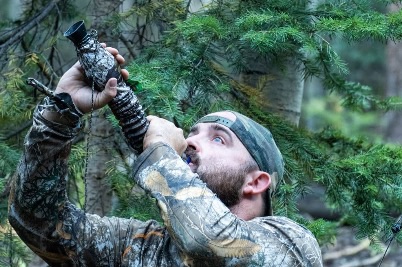
Stage two is closing the distance before you make another sound. This is where almost everybody fails. A bull answers at 400 yards, the hunter sets up right there and starts a calling sequence, and the bull holds. Now you’ve got a vocal standoff, and the bull wins it every time because he has nowhere to be.
We get to 50 to 100 yards before a cow call leaves anybody’s mouth. Then it’s light cow calling — soft, curious, not desperate. At that range you’re no longer asking a bull to cross a mountain on faith. You’re asking him to take twenty steps to look at a cow he can basically already smell.
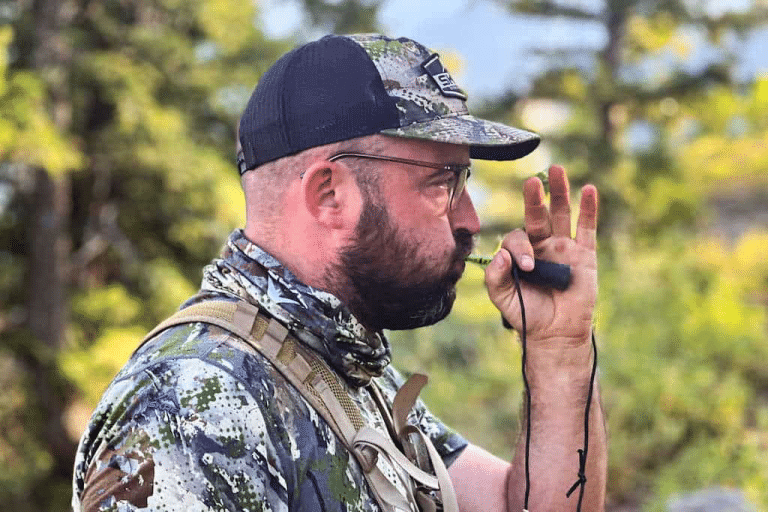
That’s the whole trick. Bugles are a locating tool. Cow calls in close are what brings home the bacon.
Where the Slow Play fits
Once we’re tight, we’ll often run some version of Medel’s Slow Play sequence — and it’s worth understanding what that actually means, because a lot of people use the phrase without knowing the mechanics.
The Slow Play is built for lazy, lethargic bugles — the bull who answers without enthusiasm. Instead of escalating, you stay patient and work a soft, unhurried sequence from a tight setup, repeating it rather than charging in. Medel’s own guidance is that you generally don’t move once you’re set, unless you realize the bull is farther off than you thought, and that once he makes any sound back at you he’s usually already on his way. Some bulls take a while. You stay put and out of sight.
The critical piece is the setup, and it’s the same reason our two-stage system works: he has to be inside your effective range before he can see where the sound is coming from. If he can look at the spot and not see an elk, he hangs up. That’s why we close to 50 to 100 yards first — a tight setup is what gives the Slow Play somewhere to work.
Moose’s Bull: Seven Yards
Last season, Moose and I were working a canyon and let out a locate bugle. A bull answered from down in the bottom.
We closed. Once we were tight, I set up roughly 50 yards behind Moose and started cow calling — which is the other half of this system nobody talks about. The caller and the shooter are not the same person and should not be in the same place. The bull is coming to the sound. The shooter needs to be between the bull and that sound.
That bull came out of his bed raking trees, absolutely hot about a whiny cow he couldn’t see. He was so locked onto me that he nearly ran Moose over. Moose killed him with a frontal shot at seven yards.
Seven yards. On public land. On a pressured bull. In a season where everybody’s telling you calling is dead.
That bull didn’t come because we out-called anybody. He came because we were close enough that investigating cost him almost nothing, and because the sound he was walking to had a bowhunter standing in front of it. He’s the same bull from our mechanical broadheads piece — Moose took him with an Evolution Hyde on a 472-grain arrow at 70 pounds, which is the gear half of the same story.
Why Bulls Answer And Won’t Come
Here’s the failure mode we hit most, and I want to be honest that there isn’t always a clean explanation.
We can see the elk. We call, they call back, and they simply refuse to close the distance. Not spooked, not leaving — just not coming. Most of the time we think the answer is boring: he doesn’t want to budge. He’s got cows, or he’s bedded and comfortable, and no amount of talking is going to make leaving worth his while.
Pressure absolutely plays into it. So does the time of season. But a lot of it is just a bull doing the math and deciding he’s already got what you’re offering.
Which is exactly why the answer is to close the gap rather than turn up the volume. You can’t argue a herd bull away from his cows from 300 yards. You can sometimes make him curious from 60.
When We Shut Up Completely
One rule, and it’s absolute: if we’re sneaking in on a known elk, nobody calls.
If we’ve already got him located and we know where he is, calling only does two things — it tells him exactly where we are, and it gives him a reason to look in our direction. Neither helps. When you know where the animal is, the hunt becomes a stalk, and stalks are won with wind and feet.
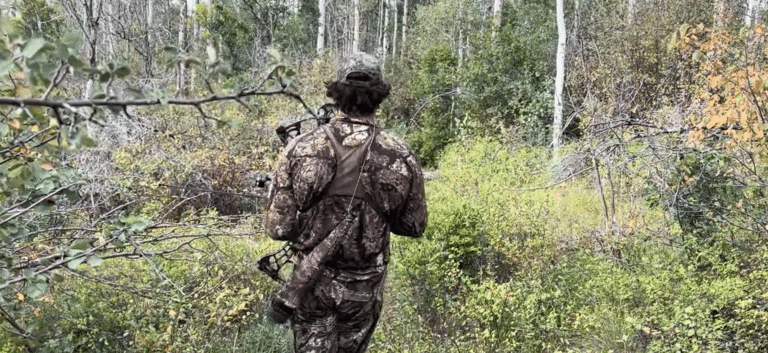
This is where Staton’s argument is dead right, and where a lot of guys who love to call talk themselves into a mistake. The call is a tool for finding and moving elk. Once you’ve found one and he’s staying put, put it away.
How Our Calling Changes Through September
- Early season: cow calls have been money. Bulls aren’t fully rutted, they’re less inclined to fight a stranger, but a cow is always worth checking on. Locate bugles to find them, cow calls to work them.
- Peak rut: this is when we get genuinely aggressive. A bull in full rut will fight, and the whole Warren playbook opens up — challenge bugles, raking, pressure. If there’s a week to be obnoxious, it’s this one.
- Late season: volume comes back down. Herd bulls go quiet and lock down, but satellite bulls are still cruising and still lonely, and that’s who you’re realistically calling to.
Through all of it, the constant is the same: get close first. Our elk calls guide and elk sounds breakdown cover what each vocalization actually means if you’re still building the vocabulary.
What We Run
You need three things to run this system, and they map directly onto the two stages. A bugle tube that throws sound across a drainage. A diaphragm you can control at low volume — because the killing call is soft, not loud. And an external cow call for the moment your mouth is dry and your hands are shaking, which is exactly the moment it matters.
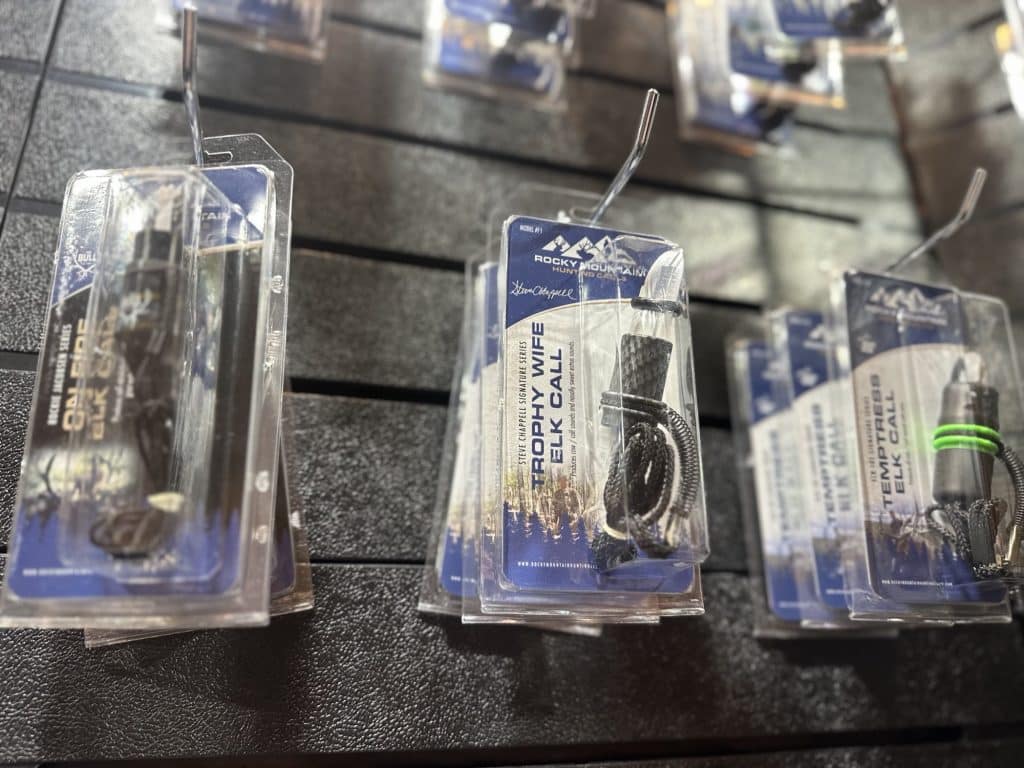
Bugle tube — for stage one
The Rocky Mountain Rogue Bugle Tube is the one we reach for. It throws a locate bugle a long way, which is the entire job — you’re asking a question across a canyon, not winning a screaming match. The Bully Bull Extreme is the pick if you want more range and volume for peak-rut aggression.
Diaphragms — for stage two
This is where the elk actually die, so carry more than one and find the one your mouth likes. The Rocky Mountain Raging Bull and Black Magic both give you soft, controllable cow sounds at close range. The Reason from Born and Raised Outdoors is about as cheap as calls get, which means no excuse for not having spares in your bino harness.
External cow call — for when you’re rattled
The Primos Hoochie Mama has called in more elk than it gets credit for, and it works when a diaphragm won’t because your mouth has gone to sandpaper. The Rocky Mountain Atomic-13 Heart Breaker is the other one we run.
The gear is not the hard part. The discipline to stop bugling and start walking is. Rest of the September kit is in our elk hunting gear rundown, and if you’re still getting dialed, start with bow hunting elk.
*Prices checked August 2026
Frequently Asked Questions
Do elk still respond to calls on pressured public land?
Yes. What changes under pressure is their willingness to travel to a call, not their willingness to answer one. That’s why the fix is closing distance rather than calling louder or more often.
What is the Slow Play in elk calling?
It’s Paul Medel’s sequence for bulls that answer lazily. Rather than escalating, you set up tight, run a soft unhurried sequence, and repeat it patiently instead of charging in. The setup is the critical part — the bull has to be inside your effective range before he can see the source of the calling, or he hangs up.
Should you bugle or cow call for public land elk?
Both, for different jobs. Bugles locate. Cow calls close. Most hunters get this backwards and try to bugle a bull into bow range from several hundred yards out.
How close should you be before you start cow calling?
We want 50 to 100 yards. Closer is better. At that range a bull only has to take a few steps to satisfy his curiosity, which is a much smaller ask than crossing a drainage.
Why do bulls bugle back but not come in?
Usually because he’s got cows or he’s bedded and comfortable, and leaving isn’t worth it to him. Pressure and season timing factor in, but often the bull has simply decided he already has what you’re advertising.
Where should the caller stand?
Behind the shooter — we run about 50 yards of separation. The bull walks to the sound, so the shooter needs to be between the bull and the caller. Moose killed his bull at seven yards because that bull was staring straight through him at me.
So — Is It Dead Or Not?
My answer is that calling elk on public land works about as well as it ever did, and that the people saying otherwise are mostly describing something they did wrong from 300 yards away. But I’ve also watched bulls that would not move for anything, and I’ve had days where the only correct call was silence.
Pick a side and defend it:
- Has calling gotten measurably worse where you hunt, or have you just gotten more honest about how it always went?
- Bugles or cow calls — which one has actually killed more elk for you?
- Is a bull that answers and won’t come a pressure problem, or is he just a bull with cows?
Comments are open, and the Final Stalk forum is where it can turn into a real argument. Bring the setup, the distance, and what the bull actually did — that’s the only version of this worth reading. And if it goes sideways this fall, our piece on wounded elk is the one nobody wants to need.
About the author
Josh Riley is a cofounder of Final Stalk and a hunting guide in Colorado’s Rocky Mountains, where he has guided for seven years and spends more than 50 days a season in elk country. What he writes here comes from what he has watched work and fail on the mountain — his own hunts, his clients’ hunts, and the ones that ended without an animal.






Leave a Reply