
I shoot 80 at a target. My limit on a live elk is 60. That gap isn’t modesty — it’s everything that can happen in the second an arrow is in the air.
Every guide gets asked how far is too far on an elk, and most of them answer with a lecture. I’m not going to. I’ve guided Colorado’s Rockies for seven years, 50-plus days a season, and I’ve stood behind hunters who made shots I wouldn’t take and hunters who passed on shots I would have. It’s their tag and their hunt. But I’ll tell you my number, why it’s lower than my target range, and the part almost nobody accounts for — what it costs you when you miss.
The short version: My ceiling on a live elk is 60 yards, and that’s in perfect conditions — calm, clear, stationary animal. Add rain, snow, or wind and I’m working to get well inside that. I can hold 75 to 80 on a target, but I still throw the occasional bad arrow at that range. On a target that’s a flier. On an elk it’s a wounded animal. The number that matters isn’t what you can hit. It’s what you can hit every single time, under pressure, on an animal that gets a vote.
My Number Is 60 — And That’s On A Perfect Day
Sixty yards is my hard ceiling on an elk. And 60 isn’t my everyday number — it’s my best case.
Sixty assumes no wind. Good light. An animal that’s relaxed and standing still. A clear lane. If any one of those is missing my number drops, and it drops fast. Rain, snow, or wind and I’m not thinking about 60 at all — I’m thinking about how to cut the distance in half.
Past 60 there are too many variables for me to manage. Not too many for me to hit the target. Too many for me to promise the outcome.
The Gap Between Your Target Range And Your Elk Range
I can shoot confidently at 75 to 80 yards on a target. I’ll still throw the occasional bad shot at that distance.
On a foam block, a bad shot is a flier. You shrug, pull the arrow, shoot again. On a bull it’s a gut shot, a shoulder, a leg — and then you’re spending five days on a blood trail like the one I wrote about in most elk aren’t killed and found. Same arrow, same archer, wildly different consequence.
So the question was never whether I can hit at 80. It’s whether I can hit at 80 every time, with my heart going, in fading light, on an animal that might take a step. The answer is no. So 60 it is.
The physics are against you out there. As Bass Pro’s breakdown of shot distance lays out, an average compound sending an arrow around 260 feet per second takes roughly half a second to reach 50 yards — and about a full second at 80. Think about what a live elk can do in one second. He can step. He can turn. He can drop at the sound of the bow. Your arrow is committed and he isn’t.
The 75-Yard Miss
Longest shot I’ve watched a client take was 75 yards. He told me he was really good at that distance. He missed.
I didn’t stop him, and I want to be clear about why. I don’t micromanage somebody’s hunt. He bought the tag, he made the call, and he’d told me what he was capable of. My job isn’t to be the ethics police standing over a guy’s shoulder.
But that’s not the same as thinking it was a good idea.
Nine Times Out Of Ten, He Comes Closer
Most of my guiding energy doesn’t go to gear or wind calls. It goes to getting excited people to sit still.
Hunters show up wound tight. That’s fine — that’s the whole point of being out there. But the first instinct of an excited hunter is almost always to shoot early. Elk in view, adrenaline up, range it, send it.
And nine times out of ten, if they’d waited, that bull was going to come closer. Especially if he’s being called in to the hunter’s position, or already headed for the water hole I put them over. He’s on a path. The hunter just has to let the path finish.
Twenty yards instead of seventy is a different sport. Most of the long shots I’ve seen taken weren’t shots that had to be taken. They were shots taken forty seconds too soon.
Which is the strongest argument for getting good at calling. If you can pull a bull to you, distance stops being a problem you solve with a sight tape. Our piece on calling elk on public land covers how we close that gap on purpose.
Why I Won’t Rank What Goes Wrong
People love to argue about which variable is the real killer at distance. Wind drift. The animal moving at the shot. Ranging error. Arrow drop. The hunter coming apart.
I won’t rank them, and ranking them is a mistake.
All of those can go wrong at any distance. A missed shot is a missed shot. Or worse — an injured animal. The outcome doesn’t care which variable caused it, and neither does the elk. What distance does is stack the odds of something from that list showing up. You’re not adding one risk when you stretch out. You’re multiplying all of them at once.
I Missed At 40. I Killed At 60.
Two years ago Moose and I came into a water hole at the same time as a bull and a cow. Moose had shots at longer distances and didn’t take them. He waited, and that bull walked into 50 yards. Moose drilled him — heart and lung, done.
We’re standing there celebrating and we hear another bull coming in. I had a tag too, so I got set.
He came in and stood at the water drinking. Perfect broadside. Forty yards. I am a crack shot at 40 yards. It’s the shot I’ve made more than any other shot in my life.

In the excitement I put my 20 pin on his vitals and released. The arrow went right under him.
He spooked, got up, and ran out to 60. Then he stopped and turned and looked straight at us for what felt like a year. Neither of us moved. Eventually he put his head back down and went to grazing, quartering away from me.
I knew I was good to 60. I figured he’d drifted out to about 63, so I put the 60 pin slightly above the heart and released. Drilled him. Perfect shot. We both killed bulls that morning.

Sit with what happened there. I missed the 40-yard chip shot and made the 60-yard shot. The distance wasn’t the problem — I was. Adrenaline put the wrong pin on an animal at a range I could shoot in my sleep, and what saved the hunt was a shot three times farther out, taken slow, with my head back on straight.
That’s why I won’t rank the variables. The one that got me wasn’t wind or drop or the elk moving. It was me, at twenty yards, on the easiest shot of the season. If it can happen to a guide with seven years of this behind him, it can happen to anybody — and every yard you add gives it more room to happen.
It’s also why 60 is still my ceiling even though 60 is where I killed that bull. That shot worked because everything lined up: he was calm, he was still, the light was good, I had time, and I’d shot that distance a thousand times. Change any one of those and I’m not drawing.
The Long Shot I’d Actually Green-Light
I’m not an absolutist, and 60 isn’t a magic number carved into rock. There are long shots I’d sign off on. They all look the same:
- Optimal conditions. No wind, no weather working against the arrow.
- Good light. If you can’t see him clearly, you can’t place it clearly.
- A stationary animal. Not walking, not alert, not looking at you.
- A clear line of sight. No branch you find out about after the fact.
- Extensive practice at that exact distance. Not “I’ve shot 70 a few times.” Hundreds of arrows, at hunting weight, with broadheads.
Miss any one of those and it isn’t the same shot anymore. Long-range shooting on animals isn’t a distance question, it’s a conditions question. A 20-yard shot at a wire-tight bull staring holes through you can be a worse bet than 40 at one that has no idea you exist.
If You’ve Been Stacking Arrows At 80 All Summer
Then take whatever shot you want. Seriously. It’s your hunt, your tag, your call.
But you are not free from the consequences of that decision, and this is the part the long-range crowd skips.
If you injure that elk, your hunt is over. Not “you get another crack tomorrow” — over. You’ll spend the rest of your week on a blood trail and go home with a story you don’t tell.
And if you miss clean? That’s not a free reroll either. You just pushed that bull over a ridge, and he is gone. Not for an hour. Gone. That was your bull and your setup, and the only thing that shot bought you was a longer walk tomorrow.
That’s the calculation nobody runs. Everybody weighs “can I make this shot” against “will I get another chance.” Almost nobody weighs it against “what happens to my hunt if I don’t.” A miss at 20 and a miss at 80 cost you the same animal — but at 20 you were far more likely to be packing him out instead.
What Actually Extends Your Range
Not a sight tape. Three things:
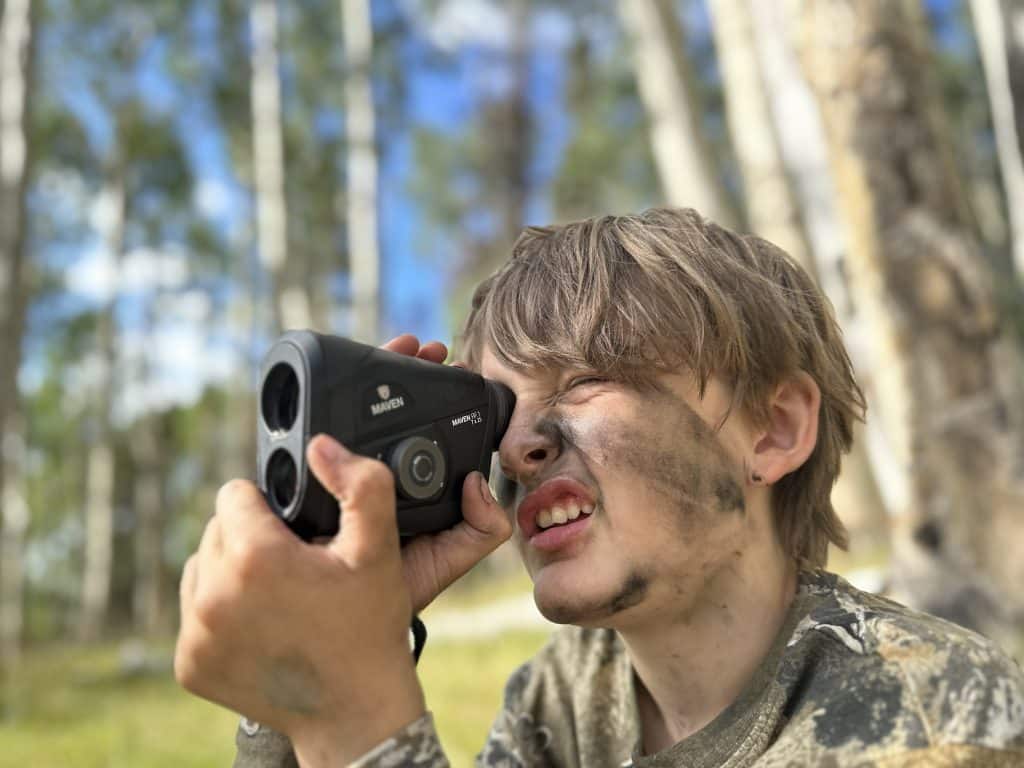
Know your true distance. Ranging error is the one variable you can eliminate outright. Range everything from your setup before an animal shows up, not while he’s standing there. Our rangefinder guide covers what matters in the mountains, and we keep a full rangefinder selection in stock.
Build a setup that forgives. Enough arrow to punch through if the angle isn’t perfect, and a head that holds together on bone — the full case is in our broadhead breakdown. Confirm you clear your state’s minimum draw weight for elk while you’re at it.
Practice the shot you’ll actually take. Out of breath, from a knee, at an angle, in bad light, with broadheads at hunting weight. Flat ground in your backyard in July is not the test.
Frequently Asked Questions
How far is too far to shoot an elk with a bow?
There’s no universal number, but my ceiling is 60 yards in perfect conditions and less in anything else. The useful test isn’t your best group — it’s the range where you’d bet the entire hunt on the next single arrow.
What’s the average shot distance on archery elk?
Most elk killed with a bow are taken well inside 50 yards, and a large share inside 30. The 70- and 80-yard shots get talked about far more than they happen.
Should I practice at 80 yards if I’ll only shoot 60?
Yes. Practicing beyond your limit tightens everything inside it — 40 feels like nothing after a summer at 80. Just don’t let the practice range become the hunting range. Those are two different numbers and they should stay that way.
Is a close shot always better?
Not automatically. A close shot at an alert, wired animal staring at you can be lower percentage than a longer one at a relaxed elk that doesn’t know you exist. Conditions matter as much as yardage.
Why do hunters miss easy close shots on elk?
Adrenaline. Close range means the animal is right there, the pressure spikes, and the routine falls apart — wrong pin, rushed release, no follow-through. I’ve missed a 20-yard broadside bull by putting the wrong pin on him, then killed him at 60 minutes later. Being close doesn’t calm you down. It usually does the opposite.
What happens if you miss an elk?
Usually you lose him entirely. A clean miss typically pushes that bull out of the drainage, and he isn’t coming back on your timeline. That cost belongs in the decision before you draw.
So Where’s Your Line?
Mine is 60 in perfect conditions and a lot less when it isn’t. I won’t tell another hunter what his number should be — but answering how far is too far on an elk honestly means being honest about your bad arrows, not just your good ones.
Pick one and defend it:
- What’s your real max on a live elk, and what’s your max on a target? If those numbers match, explain how.
- Should a guide stop a client from taking a shot he thinks is too long, or is that the hunter’s call?
- Is a clean miss actually harmless, or did you just blow your whole hunt?
Comments are open, and the Final Stalk forum is where it can turn into a real argument. Bring the distance, the conditions, and what happened after — that’s the only version of this worth reading.
About the author
Josh Riley is a cofounder of Final Stalk and a hunting guide in Colorado’s Rocky Mountains, where he has guided for seven years and spends more than 50 days a season in elk country. What he writes here comes from what he has watched work and fail on the mountain — his own hunts, his clients’ hunts, and the ones that ended without an animal.







Leave a Reply