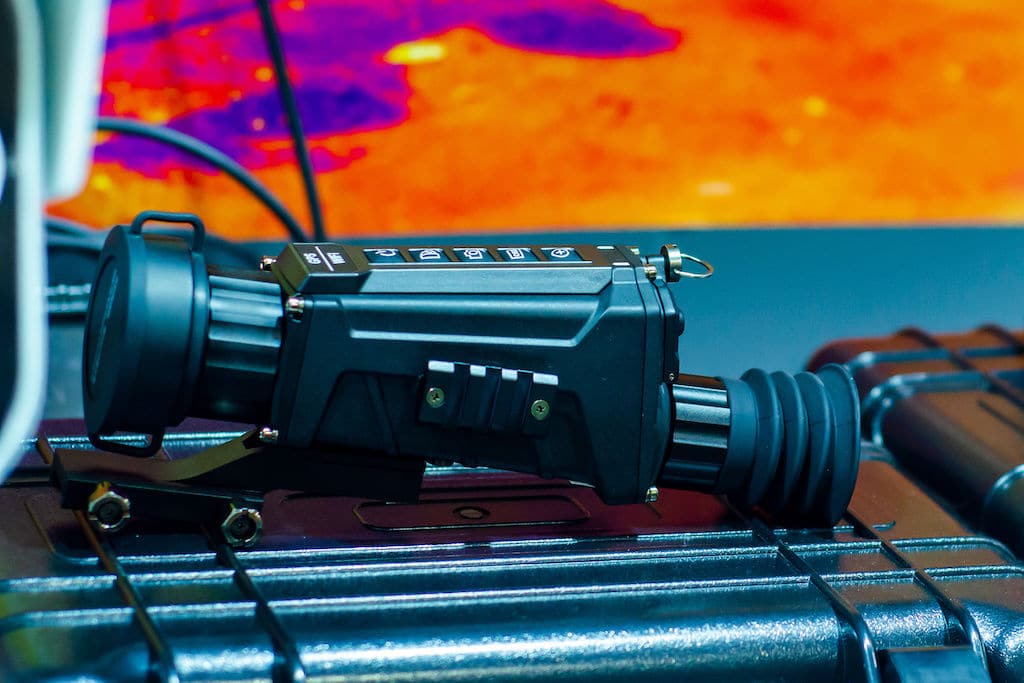
The best thermal monocular for hunting is the one that helps you find animals, not shoot them. That distinction matters more than any spec on this page. A thermal monocular is a search tool — it finds a bull bedded in dark timber you would have walked right past, a coyote working a fence line before daylight, or a blood trail that goes cold the second the sun does. If you are looking for something to shoot through, you want a thermal riflescope instead, and this is not that guide.
By Josh Riley, with field notes from Moose (Final Stalk cofounder), who brings a background in the military to his gear testing. Colorado elk, deer, moose, and bear guide, 50+ days a season in the Rockies.
Updated August 2026. Prices and availability verified at time of writing.
Quick answer: the best thermal monocular for most hunters is the Nocpix Lumi H35 — a 640×512 sensor in a sub-12-ounce body. If you want ranging built into the same unit, the AGM ReachIR LRF 35-640 gives you a 640 sensor and a 1,000-yard laser for hundreds less than the competition. On a real budget, the AGM Taipan V2 15-384 puts a genuine 384 sensor under a thousand dollars. Nine of the ten picks below ship directly from the Final Stalk shop.
This guide covers ten thermal monoculars across every price tier from $529 to $3,999, with honest notes on where the cheap ones stop working. Every pick here is judged on the two things that decide whether a thermal monocular earns its place in your pack: sensor resolution and thermal sensitivity. If you are shopping for the best thermal monocular for hunting on a fixed budget, skip to the under-$1,000 section — but read the sensor explanation first, because it is the difference between a tool and a toy.
| Monocular | Price | Sensor | NETD | Best For |
|---|---|---|---|---|
| Nocpix Lumi H35 | $2,199.00 | 640×512 | ≤18mK | Best overall for hunting |
| Pulsar Telos XP50 | $3,499.97 | 640×480 | <18mK | Best high-end and worst-weather performance |
| Sig Echo MV50-LRF | $3,299.99 | 640×512 | <25mK | Best with rangefinder |
| AGM ReachIR LRF 35-640 | $2,495.00 | 640×512 | <20mK | Best rangefinder value |
| Sig Echo MV50-DV | $3,999.99 | 640×512 | <25mK | Best dual field of view |
| Athlon Cronus ATS 35M-400 | $1,549.99 | 400×300 | ≤50mK | Best under $2,000 |
| AGM Taipan V2 19-384 | $1,395.00 | 384×288 | <20mK | Best mid-range reach |
| Pulsar Axion XQ19 Compact | $999.97 | 384×288 | <18mK | Best compact and pocketable |
| AGM Taipan V2 15-384 | $995.00 | 384×288 | <20mK | Best under $1,000 |
| ATN BlazeSeeker | $529.00 | 256×192 | <35mK | Cheapest entry point — with real limits |
*Prices checked August 2026 and subject to change.
What Moose Knows About Thermal That Most Hunters Don’t
Moose cofounded Final Stalk after a career in the military, and thermal was working equipment for him long before it was a hunting toy. He’s run ATN, AGM, Sig, and military-spec monoculars, and here’s what he told us when we asked what actually matters:
“Conditions have a huge amount to do with all thermals. Rain, fog, humidity, heat, and then the switch between morning and evening — those all change what you’re looking at. The palette you choose and the resolution of your monocular are the most important things to get right for whatever you’re dealing with that day.”
On telling a warm rock from an animal: “I mostly run white hot or red hot, in the mode that shows outlines instead of a solid blob — silhouette mode, whatever your unit calls it. What I actually look for to tell a warm rock or a patch of vegetation apart from an animal is usually the neck. That’s just something I’ve trained myself to look for over the years, and it works.”
On why hog and coyote hunters run a monocular instead of just glassing through a rifle scope: “It lets you look around and find an animal without pointing your rifle all over the place. That’s a non-negotiable in those situations. If it’s a setup where you need night vision to shoot, you use the monocular to pick the target out at distance first, then bring your night vision scope up once you know exactly what you’re looking at.”
His bottom line on sensors: “All thermals can see heat. But if you can’t tell what you’re looking at apart from a rock, it’s not that useful. The better the sensor, the better the resolution, and the better your odds of actually knowing what you found.”
Josh runs thermal for a different reason: finding downed game after dark. “A blood trail doesn’t stop being real when the sun goes down, it just gets a lot harder to see. A monocular turns a flashlight search into a five-minute scan.” Before archery season, he also glasses hillsides with thermal purely to see what’s moving — scouting only, never near an active hunt, and only where and when it’s legal to do so.
Best Overall Thermal Monocular For Hunting

Nocpix Lumi H35
Best Thermal Monocular For Hunting — 640×512 In A Sub-12 Ounce Body
A full 640×512 sensor in the lightest 640-class body Nocpix builds. This is the resolution tier Moose talks about — enough detail to actually tell an animal from a rock, not just see that something is warm.
- Sensor: 640×512, 12µm pixel pitch
- NETD: ≤18mK
- Detection Range: Up to ~1,750 yards
- Weight: Under 12 oz
- Battery: Removable 18650
- Best For: Scouting, blood-trail recovery, and general scanning where weight and resolution both matter
- 640-class resolution at a genuinely carryable weight
- ≤18mK NETD holds up in fog and after rain
- Runs on common 18650 batteries — cheap and easy to replace
- No built-in rangefinder on this model (the H35R adds one)
- 2.5x base magnification means digital zoom does more of the work at real distance
This is the sensor class Moose was talking about when he said the difference between good and useless thermal comes down to resolution. A 640 sensor is what lets you find the neck, not just the blob. If you only buy one thermal monocular and you want it to still be the right call in three seasons, this is it.
Best High-End Thermal Monocular

Pulsar Telos XP50
Best High-End Thermal Monocular — Lynred Sensor, Under 18mK NETD
Pulsar’s flagship handheld replaces the discontinued Helion 2 Pro. A Lynred-made 640×480 sensor with an under-18mK NETD rating is about as sensitive as commercial hunting thermal gets, and the modular body means it can be upgraded rather than replaced.
- Sensor: 640×480, 17µm pixel pitch, Lynred
- NETD: <18mK sensor, <15mK system
- Objective: F50/1.0 germanium
- Magnification: 2.5x base, 2.5-10x smooth zoom, up to 20x with Zoom Boost
- Display: 1024×768 AMOLED
- Detection Range: Up to ~1,900 yards
- Battery: LPS 7i 6400mAh, ~8.5 hours, USB-C and wireless charging
- Weight: 25.3 oz
- Best For: Hunters who want the sharpest available image in genuinely bad weather
- Among the most sensitive NETD ratings on the commercial market
- Modular design allows future component upgrades
- Camera-style adjustment rings for smooth zoom and focus without looking away
- The most expensive non-Sig pick on this list
- At 25.3 oz it is more than twice the weight of the Lumi H35
Straight from Moose: conditions are the whole game with thermal, and this is the unit built specifically to keep working when fog, rain, or a temperature swing degrades everything around it. Pulsar publishes full specifications if you want to compare it against the rest of the Telos family.
Best Thermal Monocular With A Rangefinder

Sig Sauer Echo MV50-LRF
Best Thermal Monocular With Rangefinder — 640×512 Plus Integrated Laser
A 640×512 sensor with a laser rangefinder built into the same housing. For recovery work in broken country, knowing a heat signature is 380 yards out and not 180 changes how you plan the walk in.
- Sensor: 640×512, 12µm pixel pitch
- Objective: 50mm
- Magnification: 3-24x
- Rangefinder: Integrated laser
- Best For: Hunters who want one device that finds the animal and tells them how far it is
- Ranging and thermal in a single unit — one less thing on the bino harness
- 50mm objective gives real reach for open-country glassing
- Sig’s electronics and warranty support behind it
- Costs $800 more than the AGM ReachIR below for a comparable sensor
- Larger and heavier than the compact picks
If budget is not the deciding factor, this is the most polished rangefinding thermal on the list. If it is, read the next pick carefully — the value gap is significant.
Best Rangefinder Value

AGM ReachIR LRF 35-640
Best Rangefinder Value — 640×512 And A 1,000-Yard Laser
The same 640-class sensor tier as the Sig, with a sub-20mK NETD rating and a 1,000-meter laser rangefinder accurate to a meter — for hundreds less. This is the best price-to-capability ratio on the page.
- Sensor: 640×512, 12µm VOx uncooled
- NETD: <20mK
- Objective: 35mm F1.0
- Magnification: 2-16x
- Rangefinder: 1,000m / 1,093 yards, ±1m accuracy
- Detection Range: 1,800 yards on a 6-foot object
- Display: 1024×768 OLED, 50Hz
- Battery: Removable 18650, up to 4.5 hours
- Weight: 14.1 oz without battery
- Best For: Getting 640 resolution and ranging without paying flagship prices
- 640×512 and an integrated laser for well under $2,500
- Magnesium alloy housing, IP67, and a -22°F to 131°F operating range
- Non-proprietary 18650 battery — carry spares for pennies
- 4.5 hours of runtime is the shortest on this list — bring extra cells
- Four palettes only, versus eight on the Pulsar units
If you are choosing between this and the Sig MV50-LRF purely on capability, the honest answer is that the gap is smaller than the price difference suggests. AGM’s published specifications are worth reading side by side with Sig’s before you commit.
Best Dual Field Of View Thermal Monocular

Sig Sauer Echo MV50-DV
Best Dual Field Of View — Wide Scanning And Narrow Identification In One Unit
The dual-view design solves a real problem: wide fields of view are better for finding things, narrow fields are better for identifying them. Most monoculars force you to pick one and live with digital zoom. This one gives you both optically.
- Sensor: 640×512, 12µm pixel pitch
- Magnification: 1.5-24x across two optical fields of view
- Objective: 25mm wide / 50mm narrow
- Best For: Hunters who scan large country and then need to identify what they found
- Two genuine optical fields of view, not digital zoom pretending to be one
- Scan wide, then switch to narrow for identification without swapping devices
- 640×512 sensor behind both
- The most expensive pick on this list
- The dual-optic design adds bulk over a single-objective unit
This directly addresses the detection-versus-identification problem that trips up most thermal buyers. Wide FOV finds the heat signature; narrow FOV tells you whether it has a neck. It is an expensive way to solve that, but it is the cleanest solution here.
Best Thermal Monocular Under $2,000

Athlon Cronus ATS 35M-400
Best Thermal Monocular Under $2,000 — 400×300 At 12.3 Ounces
A higher-resolution sensor than most units at this price still ship with, in one of the lightest bodies in its class, backed by Athlon’s lifetime transferable warranty.
- Sensor: 400×300, 12µm pixel pitch
- NETD: ≤50mK
- Detection Range: Up to ~3,000 yards
- Weight: 12.3 oz
- Warranty: Lifetime transferable, no receipt required
- Best For: A step above entry-level resolution without a flagship price
- 400×300 beats the 384×288 sensors common at this price
- Genuinely lightweight for all-night carry
- Athlon’s lifetime transferable warranty is the best coverage here
- ≤50mK NETD is the least sensitive on this list — it will show its limits in fog or heavy rain
- Newer brand in thermal with a shorter track record than Pulsar or AGM
Worth being straight about the trade here: you get more pixels than the 384 units but noticeably less sensitivity. In clear, cold conditions that is a good deal. In the fog and post-rain conditions Moose flagged as the hardest test, a <20mK 384 sensor may actually serve you better than a 50mK 400.
Best Mid-Range Thermal Monocular

AGM Taipan V2 19-384
Best Mid-Range Thermal Monocular — More Reach Than The 15mm, Same Sensor
The 19mm lens trades some field of view for meaningfully more detection distance than its 15mm sibling. If you glass open country rather than thick timber, this is the Taipan to buy.
- Sensor: 384×288, 12µm VOx uncooled
- NETD: <20mK
- Objective: 19mm F1.0 germanium
- Magnification: 2-16x
- Field of View: 13.7° x 10.3°
- Detection Range: 950m / ~1,040 yards
- Display: 1024×768 OLED, 50Hz
- Battery: Removable 18650, 6.5+ hours
- Weight: ~11 oz
- Warranty: AGM 5-year
- Best For: Open-country scanning where reach matters more than a wide field
- Sub-20mK sensitivity at a mid-range price
- 90° tilt sensor kills the display when stowed, stretching battery life
- Picture-in-picture and stadiametric ranging built in
- Narrower field of view than the 15-384 makes initial scanning slower
- Four palettes and 16GB storage — functional, not generous
The Taipan V2 line is where AGM put its sub-20mK sensor into an affordable body. Between this and the 15-384 below, the only real question is whether you scan wide or scan far.
Best Compact Thermal Monocular

Pulsar Axion XQ19 Compact
Best Compact Thermal Monocular — Under 9 Ounces, Under $1,000
A European-made 384×288 sensor with an under-18mK system NETD in a magnesium body that fits a bino harness pocket. This is the one you actually carry, because you never notice it is there.
- Sensor: 384×288, 17µm, European-made uncooled
- NETD: <18mK system, <25mK sensor
- Objective: F19/1.0
- Magnification: 1.5-6x with 4x digital zoom
- Field of View: 19.5° x 12.3° — the widest here
- Detection Range: 750m / 820 yards
- Display: 640×400 AMOLED
- Battery: Quick-swap APS3, 8 hours
- Weight: Under 9 oz
- Body: Magnesium alloy, IPX7
- Best For: Hunters who want thermal on every trip without a weight penalty
- Under-18mK system NETD is flagship-grade sensitivity at an entry price
- Widest field of view on this list — excellent for fast scanning
- Eight color palettes and quick-swap batteries
- 820-yard detection is the shortest reach of the serious picks
- 640×400 display is lower resolution than the 1024×768 units
The sensitivity number here is the story. An under-18mK system NETD on a sub-$1,000 monocular is unusual, and it is exactly the spec that keeps working when the weather turns. The trade is reach: the 19mm lens is built for scanning close-to-mid country, not reaching across a canyon.
Best Thermal Monocular Under $1,000

AGM Taipan V2 15-384
Best Thermal Monocular Under $1,000 — A Real 384 Sensor At Sub-20mK
This is the cheapest monocular on the list we would actually recommend as a primary unit. A genuine 384×288 sensor at sub-20mK sensitivity, with a wide 15mm lens built for scanning timber.
- Sensor: 384×288, 12µm VOx uncooled
- NETD: <20mK
- Objective: 15mm F1.0 germanium
- Magnification: 1.5-12x
- Display: 1024×768 OLED, 50Hz
- Battery: Removable 18650, 6.5+ hours
- Storage: 16GB onboard, Wi-Fi via AGM Connect
- Weather Rating: IP67
- Warranty: AGM 5-year
- Best For: The best sensor you can get under a thousand dollars
- Sub-20mK sensitivity is remarkable at this price
- Wide 15mm lens scans timber and brush quickly
- Removable 18650 and a 5-year warranty
- Shorter detection range than the 19mm version
- 384×288 will identify at shorter distances than any 640 unit here
Here is the honest version of the budget conversation. Under $1,000 you are buying detection, not identification. A 384 sensor will reliably show you that something warm is in the timber at 300 yards; it will not always tell you whether that something is a cow elk or a horse. That is a real limitation, and no amount of digital zoom fixes it — zoom enlarges pixels, it does not create detail. What this unit does is put you on the right side of the line Moose drew: enough resolution to usually know what you found.
Cheapest Thermal Monocular — And What You Give Up
ATN BlazeSeeker
Cheapest Way Into Thermal — 256×192, With Real Compromises
At around $529 this is the least expensive thermal monocular worth listing at all. It works. It will show you heat signatures in the dark. But the 256×192 sensor is exactly the tier Moose warned about, and you should know that going in.
- Sensor: 256×192, 12µm
- NETD: <35mK
- Refresh Rate: 50Hz
- Display: 720×540 LCOS
- Battery: 9+ hours
- Weather Rating: IP67
- Variants: 207 (1.8-8x, 7mm) and 210 (1.5-12x, 10mm)
- Best For: Finding out whether thermal fits how you hunt before spending real money
- Under $530 — genuinely the cheapest honest entry point
- 9+ hours of battery life, the longest runtime here
- Good enough for close-range recovery work in open ground
- 256×192 shows you heat, not identity — blobs, not necks
- <35mK sensitivity degrades quickly in fog, rain, and humidity
- Short detection range compared to every other pick here
You get what you pay for, and this is what $529 buys. That is not a knock on ATN — it is physics. A 256×192 sensor has roughly a fifth the pixels of a 640×512, so at any given distance you are working with a fraction of the detail. Buy this if you want to learn whether thermal earns a place in your kit. If you already know it does, the extra $466 to the Taipan V2 15-384 is the single best-value upgrade on this page.
How To Choose A Thermal Monocular
Sensor Resolution
This is the number that matters most, and it’s the one Moose kept coming back to. A 256×192 sensor will tell you something warm is out there. A 640-class sensor is what lets you actually identify it. Budget accordingly — a cheap thermal that only shows blobs isn’t saving you money, it’s wasting it.
NETD
Noise Equivalent Temperature Difference measures how small a temperature difference the sensor can actually resolve. Lower is better. This is the spec that decides whether your monocular still works when fog rolls in, right after rain when everything in the scene is the same temperature, or in the low-contrast light of dawn and dusk — exactly the conditions Moose flagged as the hardest test for any thermal unit. Note that a sensitive 384 sensor can outperform an insensitive 400 or 640 in bad weather, which is why NETD deserves as much attention as resolution.
Objective Lens Size
Bigger objectives reach farther and narrow your field of view; smaller objectives scan wide and give up distance. A 15mm or 19mm lens is right for timber and brush where you are sweeping close country fast. A 35mm or 50mm lens is right for open country where you are trying to pick a heat signature out of a far hillside. This is the single most under-considered spec in thermal shopping.
Color Palette
White hot and black hot are the two most common palettes, and most experienced users settle on one. Moose runs white hot or red hot in outline/silhouette mode rather than a solid-heat display, because outlines make it easier to read body shape — which is how he tells an animal from a warm rock.
Detection Range vs. Identification Range
Every manufacturer advertises detection range — the distance at which the sensor sees a heat source at all. That number is not what tells you whether it’s a deer, a dog, or a rock. Identification range is always significantly shorter, and it depends on sensor resolution, NETD, and honestly, practice. Don’t buy on the detection number alone.
Battery System
Removable batteries matter more than total runtime. A unit with a sealed internal cell and 8 hours of life is worse on a multi-day trip than one with a removable 18650 and 4.5 hours, because you can carry three spare 18650s in a pocket for the price of a sandwich. Every AGM and Nocpix pick here uses non-proprietary 18650 cells.
Frequently Asked Questions
What is the best thermal monocular for finding downed game?
Higher resolution helps most here, since you’re often looking for a small, cooling heat signature in brush. The Nocpix Lumi H35’s 640×512 sensor is the strongest pick for recovery work specifically. If you want ranging in the same unit, the AGM ReachIR LRF 35-640 does the same job and tells you how far the walk is.
Can you use a thermal monocular for scouting before season?
Yes, and it’s one of the best uses for one — scanning hillsides to see what’s moving before opening day. Check your state’s regulations first, since rules on thermal use vary by state and by whether a season is open. Colorado Parks and Wildlife publishes its current regulations online, and most state agencies do the same. Never use thermal to locate game during an active hunt where it isn’t explicitly legal to do so.
How do you tell an animal from a warm rock on thermal?
According to Moose, look for the neck. Rocks and vegetation hold heat in irregular, static shapes; an animal has a consistent silhouette, and the neck is usually the clearest tell. Running your unit in outline mode instead of solid-heat display makes this easier to see.
Do I need a thermal monocular if I already have a thermal riflescope?
If you hunt predators at night, yes. A monocular lets you scan and identify a target without pointing a rifle at it — a real safety consideration when you’re searching, not yet shooting. Once you’ve identified the target with the monocular, you bring the weapon-mounted optic up to take the shot.
What’s the difference between detection range and identification range?
Detection range is the distance at which a heat source is visible at all. Identification range — always shorter — is the distance at which you can actually tell what it is. Manufacturers advertise the bigger number; judge a unit by the smaller one.
Is a 384 thermal monocular good enough for hunting?
For scouting and close-to-mid-range recovery work, yes — especially a sensitive one like the sub-20mK Taipan V2 or the sub-18mK Axion XQ19. Where 384 falls short is identification at distance. If you routinely need to know what you are looking at past 300 yards, step up to a 640.
Do thermal monoculars work in rain and fog?
They work, but reduced. Water vapor absorbs infrared, so heavy fog and hard rain cut effective range significantly. This is where NETD earns its keep — a sub-18mK unit like the Telos XP50 or Axion XQ19 keeps resolving usable detail in conditions where a 50mK sensor turns the whole scene to grey soup.
Why Trust Us
Josh Riley guides elk, deer, moose, and bear hunts in Colorado’s Rocky Mountains 50-plus days a season, and uses thermal for pre-season scouting and after-dark game recovery. Moose, Final Stalk’s cofounder, ran thermal and night vision professionally during his time in the military before he ever pointed a monocular at game — the field notes on this page are his, in his own words.
Final Stalk stocks thermal optics from AGM, Athlon, Nocpix, Pulsar, and Sig Sauer. Nine of the ten monoculars featured here are units we carry and can ship directly; the ATN BlazeSeeker is included because it is the honest answer to the cheapest-possible question, and we would rather tell you what it gives up than pretend it doesn’t exist.
Straight talk: this guide covers scouting and game recovery, not hog or predator hunting specifically — that’s a different use case with its own legal landscape we don’t claim deep authority on. Thermal-use laws for hunting vary significantly by state and by species. Check your local regulations before using any thermal device in the field, and never use one to locate game during an active big-game hunt unless it is explicitly legal to do so.
Some links on this page earn Final Stalk a commission at no additional cost to you. Products sold through our own shop are ones we stock and stand behind.
Which Thermal Monocular Fits How You Hunt?
Choosing the best thermal monocular for hunting comes down to three questions: how much resolution you need to identify what you find, how far you need to reach, and whether you want ranging in the same device. If you want one answer, the Nocpix Lumi H35 is the pick that satisfies the most hunters. If you want the most capability per dollar, it is the AGM ReachIR LRF 35-640. And if a thousand dollars is the ceiling, the AGM Taipan V2 15-384 puts you on the right side of the sensor line.
Round out your glassing kit with a spotting scope and a laser rangefinder for daylight glassing. If you are building out a full backcountry setup, our guides to hunting boots, long range walkie talkies, and the complete elk hunting gear list cover the rest of the kit.
Run Thermal? Tell Us What You’ve Learned.
Every thermal user has a story about a night the palette or the weather made or broke a find. Maybe you’ve got a trick for telling animal from rock that beats looking for the neck. Maybe you think a 384 does everything you need and the resolution arms race is overkill.
Drop a comment below with what you run and what you’ve learned the hard way — or take it to the Final Stalk forum, where the gear talk runs all season.
Shop All Thermal Optics At Final Stalk






Leave a Reply