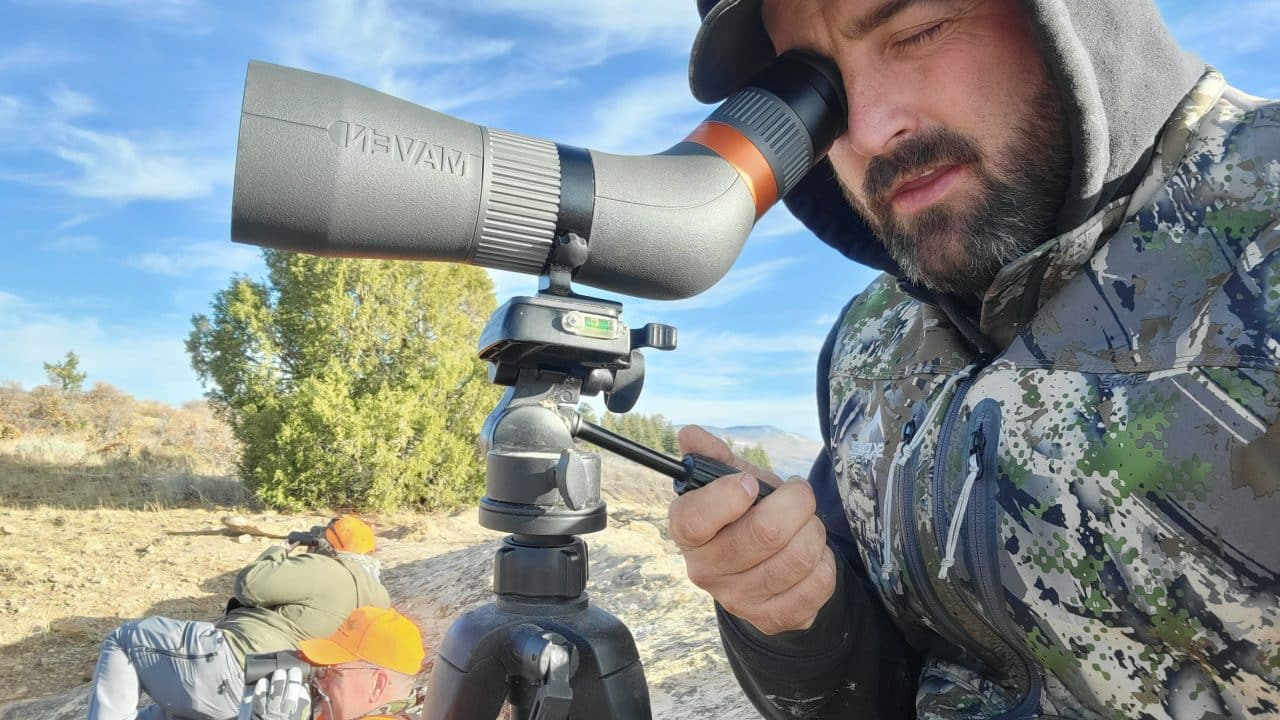
Finding the best spotting scope for hunting comes down to one honest question: how far do you have to carry it, and how long will you sit behind it? I’ve spent enough Colorado mornings glassing dark timber until my eyes watered to know that the scope that wins on a spec sheet isn’t always the one that finds elk.
By Josh Riley — Colorado elk, deer, moose, and bear guide. 50+ days a season behind glass in the Rocky Mountains. Cofounder of Final Stalk.
Updated July 2026. Prices and availability verified at time of writing.
Few pieces of gear are as coveted by hunters, shooters, and wildlife watchers as their glass. A quality spotter will likely be one of the most expensive items in your pack — and one of the most important. Getting this purchase right can mean the difference between a punched tag and eating tag soup.
Public land pressure keeps pushing animals farther out, which means spotting critters at distance isn’t optional anymore. So we sorted the whole market, from scopes under $100 up to the alpine glass that costs more than some rifles.
Quick answer: the best spotting scope for hunting in 2026 is the Leupold SX-4 Pro Guide HD Gen 2 — American-built, waterproof, and the best glass you can get without crossing $1,500. Best spotting scope for the money goes to the Vortex Viper HD at $699. On a tighter budget, the Leupold SX-2 HD at $399.99 punches far above its price, and the Konus 20-60×70 gets you real glass for $164.99. We stock all three in the Final Stalk shop.
| Spotting Scope | Price | Magnification | Weight | Best For |
|---|---|---|---|---|
| Leupold SX-4 Pro Guide HD Gen 2 | $1,199.99 | 20-60×85 | 78.2 oz | Best overall for hunting |
| Vortex Viper HD | $699.00 | 15-45×65 | 59.0 oz | Best spotting scope for the money |
| Leupold SX-2 HD | $399.99 | 20-60×60 | 33.4 oz | Best budget scope under $500 |
| Vortex Diamondback HD | $449.99 | 20-60×85 | 33.8 oz | Under $500 for target shooting |
| Konus 15-45×65 | $299.99 | 15-45×65 | — | Best under $300 |
| Konus 20-60×70 | $164.99 | 20-60×70 | — | Best under $200 |
| Emarth 20-60×60 | $59.99 | 20-60×60 | 48.1 oz | Best cheap scope under $100 |
| Vortex Razor HD | $1,449.99 | 13-39×56 | 25.0 oz | Best compact for backpack hunts |
| Maven CS.1A | $925.00 | 15-45×65 | 40.4 oz | Best packable for elk hunting |
| Leupold Mark 4 | $1,599.99 | 20-60×80 | 61.8 oz | Best for long-range target shooting |
| Leica APO-Televid | $3,199.00 | 25-50×65 | 51.1 oz | Best high-end glass |
*Prices checked July 2026 and subject to change.
Best Overall Spotting Scope For Hunting
Our Top Pick

Leupold SX-4 Pro Guide HD Gen 2
Best Spotting Scope For Hunting — American-Built 20-60×85
The most capable spotting scope you can buy without crossing into $2,000+ alpine glass. Waterproof, fogproof, and built to survive a backcountry season.
- Magnification: 20-60×85
- Eyepiece Position: Angled or straight
- Eye Relief: 17.8mm – 19mm
- Weight: 78.2 oz
- Best For: Serious Western hunters who want elite glass without alpine pricing
From the field: I’ve used the SX-4 many times and glassed elk with it with ease. It’s super agile on the tripod, and the sight picture is crystal clear right out to the top of the magnification range. Dollar for dollar I ranked it number one because it’s genuinely high-end glass at a reasonable price — you’re not paying the alpine tax to get alpine-adjacent performance.
- DiamondCoat 2 lens coating for genuine low-light performance
- 100% waterproof and fogproof
- Leupold’s lifetime warranty and US-based service
- Available angled or straight
- Heavy at 78.2 oz — this is a truck-and-glassing-knob scope
- Gen 1 SX-4 is discontinued, so used listings may be older stock
The feature doing the heavy lifting is the DiamondCoat 2 ion-assist lens coating, which maximizes light transmission. That matters most at dawn and dusk, exactly when big game moves and when cheaper glass turns to gray mush. Leupold publishes full specs if you want to compare eyepiece configurations.
We stock both the angled and straight 20-60×85 in the shop, plus the lighter 15-45×65 for hunters who want the same optical system in a smaller package.
Best Spotting Scope For The Money
Best Value

Vortex Viper HD
Best Spotting Scope For The Money — $699 With A Lifetime Warranty
A staple among hunters, guides, and target shooters. It sits exactly at the intersection of quality, performance, and price.
- Magnification: 15-45×65
- Eyepiece Position: Angled or straight
- Eye Relief: 17.8mm – 19.6mm
- Weight: 59.0 oz
- Best For: The hunter who wants 80% of alpine glass for 30% of the money
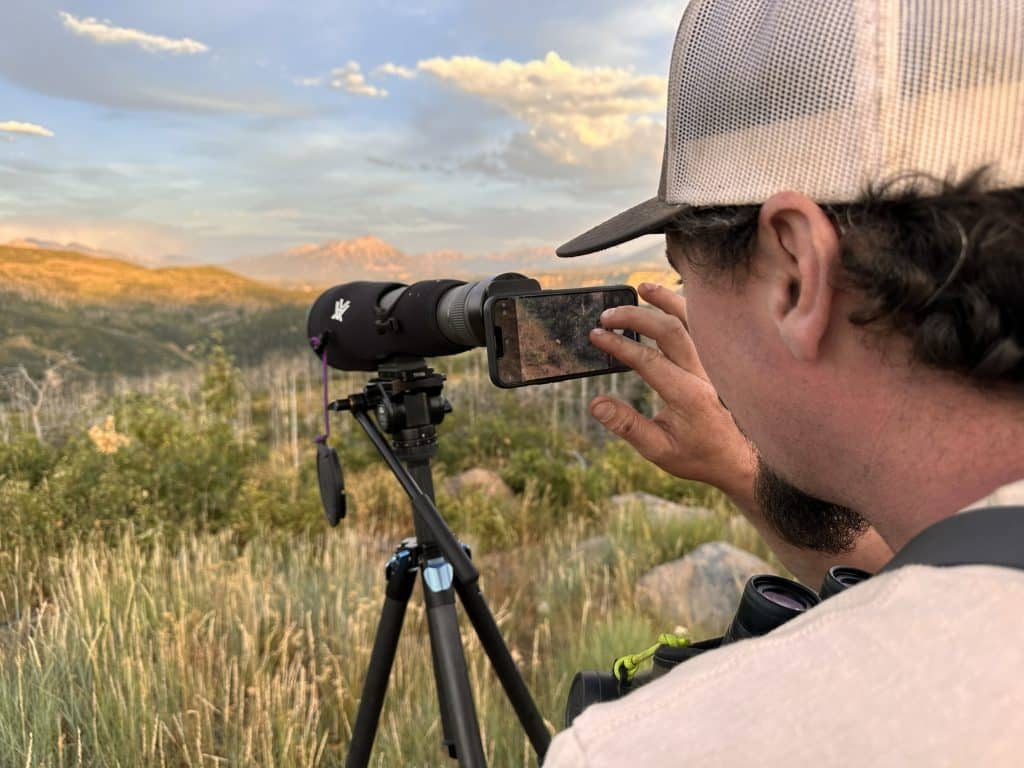
From the field: I own a few pieces of Viper glass and it holds up to my rough-and-tumble backcountry style. I’ve also broken a pair of Viper binoculars (eyepiece, my fault) — sent them in on a Tuesday, had a replacement pair by the end of that week. That warranty is a real part of the value, not marketing.
- Punches well above its price bracket optically
- Vortex VIP warranty is unconditional and transferable
- Excellent eye relief for glasses wearers
- Focus wheel is stiff out of the box for some users
- Heavier than the compact options below
If you want more objective lens, the 85mm version costs a bit more and gains noticeable brightness. Pair either with a solid hunting rangefinder and you’ve covered your long-range glassing kit.
Best Budget Spotting Scope Under $500
In Stock At Final Stalk

Leupold SX-2 HD
Best Budget Spotting Scope Under $500
Field & Stream’s testers named the SX-2 their best budget spotter, and we agree — it delivers most of what a new Western hunter needs at a fraction of premium pricing.
- Magnification: 20-60×60 (80mm also available)
- Eyepiece Position: Angled
- Price: $399.99 (60mm) / $499.99 (80mm)
- Best For: First-time Western hunters and anyone who won’t spend four figures on glass
- Independent testers rate it the top value spotter on the market
- Smooth, easy focus and magnification wheels
- Full Leupold lifetime warranty at a budget price
- In stock and shipping from our shop
- Falls short of premium glass in clarity and low light
- You’ll see fewer fine details at max magnification
Field & Stream’s optics testers put it plainly after hands-on evaluation: the SX-2 isn’t overly heavy, its focus and magnification wheels are easy to control, and while it gives up ground in clarity and low-light performance, the value is unmatched at roughly $3,000 less than premium spotters — performing just fine for most hunters or those getting started in Western big game hunting. That matches what we see from customers.
If you want a bit more objective lens, we also stock the SX-2 HD in the larger configuration at $499.99, and the SX-2 Alpine HD Gen 2 20-60×80.
Runner-Up

Vortex Diamondback HD
Best Spotting Scope Under $500 For Target Shooting
The first spotting scope I ever bought, back in my first year guiding elk hunts. It helped put my hunters on three 6×6 bulls that season.
- Magnification: 20-60×85
- Eye Relief: 14.0mm – 17.0mm
- Weight: 33.8 oz
- Best For: Shot groups out to about 200 yards and general glassing
From the field: This was the first spotting scope I ever bought — my first year guiding elk hunts, and I thought I was splurging. It helped put my hunters on three 6×6 bulls that season. I’ve since upgraded to the Viper HD, but the Diamondback still comes out from time to time.
- Big 85mm objective for the price
- Vortex VIP lifetime warranty
- Less eye fatigue on long glassing sessions
- Focus gets finicky at the top of the magnification range
- Stiff zoom ring according to some owners
For spotting hits past 200 yards, step up to the Viper — below that, this does the job.
Best Spotting Scope Under $300
In Stock At Final Stalk

Konus 15-45×65
Best Spotting Scope Under $300
A 65mm objective and a usable 15-45x range at a price that leaves money for a decent tripod — which matters more than most buyers realize.
- Magnification: 15-45×65
- Price: $299.99
- Best For: Budget-conscious hunters who still want a real 65mm objective
- Genuine 65mm glass under $300
- Deep stock — ships immediately
- Lower magnification ceiling means a steadier, more usable image
- Not a low-light performer like the Leupolds above
- 45x ceiling limits precision target work
Also worth a look at this tier: the Bushnell Prime ($329.95) and the Bushnell Trophy Xtreme, which is genuinely light at 21.5 oz and throws onto a shooting stick fast. I used one glassing elk in Colorado and liked how quickly it produced a sharp image — though I wouldn’t push it past 1,000 yards.
Best Spotting Scope Under $200
Best Stocked Budget Pick

Konus 20-60×70
Best Spotting Scope Under $200 — 70mm For $164.99
A 70mm objective with a full 20-60x zoom range for under $165 is a lot of scope for the money, and it’s the deepest-stocked spotter we carry.
- Magnification: 20-60×70
- Price: $164.99
- Best For: New hunters, backup glass, or a truck scope
- Largest objective in this price bracket
- Full 60x top end for spotting hits at the range
- Cheap enough to leave in the truck without worry
- Image softens noticeably above 40x
- Not built for hard backcountry abuse
The Athlon Talos ($178.49) is the other strong sub-$200 option — some owners report picking out individual leaves at 900 yards. We also stock it at $249.99 in the shop if you’d rather buy from us.
Best Cheap Spotting Scope Under $100
Budget Buy
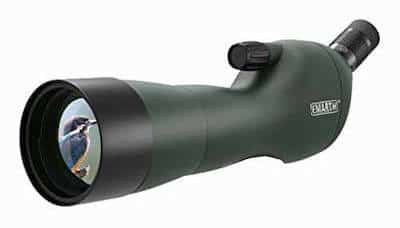
Emarth 20-60×60
Best Spotting Scope Under $100
At $59.99 this is a starter scope, not an investment — but for a new shooter or a kid’s first spotter, it beats nothing at all.
- Magnification: 20-60×60
- Weight: 48.1 oz
- Price: $59.99
- Best For: Absolute beginners and casual backyard use
- Thousands of positive Amazon reviews
- Works for digiscoping the moon and casual wildlife
- Costs less than a box of premium ammo
- Clarity is exactly what $60 buys
- Not recommended past 200 yards for target work
- Durability is a real question over multiple seasons
Be honest with yourself about what this is. If you’re hunting seriously, save up for the Konus or the SX-2 instead — you’ll outgrow this in a season.
Best Compact Spotting Scope For Backpack Hunting
Lightest Pick

Vortex Razor HD 13-39×56
Best Compact Spotting Scope For Backcountry Hunts
At 25 oz this is the scope for hunters counting every ounce. Field & Stream’s testers measured it 12 ounces lighter than the next-best compact they evaluated.
- Magnification: 13-39×56
- Eye Relief: 16.0mm – 19.0mm
- Weight: 25.0 oz
- Best For: Drop-camp and multi-day backcountry hunts where ounces matter
- One of the lightest quality spotters made
- Excellent build quality and smooth adjustment knobs
- Vortex VIP warranty
- Expensive for a scope that tops out at 39x
- Not the pick for precision target shooting
- Magnification dial stiffens in cold weather
Field & Stream ran this on a week-long backcountry archery elk hunt and a late-season mule deer hunt, and rated its build quality and ergonomics with the best they tested. If you’re shopping purely on weight, this is the answer — you’re paying for what you don’t carry.
Worth understanding the trade-off before you commit: as GOHUNT explains in their compact spotter breakdown, compact scopes with 50–56mm objectives gather less light than 65mm or larger models, so at higher magnifications you may notice reduced brightness and resolution — that’s just physics, since smaller lenses have smaller exit pupils, and once you drop below about 2mm, image quality starts to fade.
Best For Elk Hunting

Maven CS.1A
Best Packable Spotting Scope For Elk Hunting
More reach than the Razor HD, still light enough to carry all day. Wyoming-built and sold direct, which keeps the price honest for the glass quality.
- Magnification: 15-45×65
- Eye Relief: 16mm – 19mm
- Weight: 40.4 oz
- Price: $925.00
- Best For: Archery elk hunters glassing aspen pockets and dark timber
From the field: We used this glassing far-off ridges in Colorado, looking for elk holding between the white slats of aspens. We turned up a few bulls that ultimately dodged our arrows — but the glass did its job, and carrying it never strained a back or overfilled a pack.
- Bright, detailed glass in a genuinely packable size
- 11.4″ long — shorter than a ruler
- Direct-to-consumer pricing beats comparable retail glass
- Still nearly a pound heavier than the Razor HD
- Direct-only sales mean you can’t handle one at a shop first
Pair it with a good set of hunting binoculars and you’ve got a complete glassing system.
Best Spotting Scope For Long Range Target Shooting
Tactical Pick
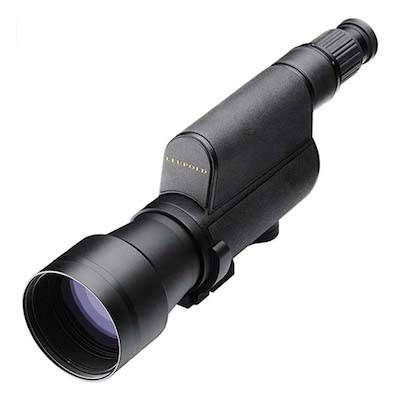
Leupold Mark 4
Best Spotting Scope For Long Range Target Shooting
If this isn’t the military’s standard spotter, it should be. Fast target acquisition, a TMR reticle for calling shots, and 30mm of eye relief.
- Magnification: 20-60×80
- Eyepiece Position: Straight
- Eye Relief: 30.0mm
- Weight: 61.8 oz
- Best For: Precision rifle shooters and spotters calling wind
- Best-in-class 30mm eye relief
- TMR reticle lets a spotter call corrections directly
- Twilight Max Light Management System extends usable glassing light
- Overkill and overpriced for casual hunters
- Straight body is less comfortable for seated glassing
For pure magnification at the range, the Vortex Razor HD 27-60×85 ($1,699, down from $2,399) is the value play. We also stock the Sig Oscar6 HDX ($2,199.99) for shooters who want ranging and glassing in one system.
Best High-End Spotting Scope
This is the tier where you stop buying magnification and start buying resolution — the ability to tell a 5×5 from a 6×6 at two miles in flat evening light. If you hunt for a living or you’ve simply decided this is the purchase you make once, here’s where to look.
Best Glass On The List

Leica APO-Televid 25-50×65
Best High-End Spotting Scope For Hunting
Achromatic lenses paired with fluorite glass. Testers report no color shifting, no blurring, and no stray light — even shooting into the sun.
- Magnification: 25-50×65
- Price: $3,199.00
- Best For: Hunters and guides who need to judge animals at extreme distance
- Effectively flawless optical performance in independent testing
- Holds image quality in low light better than nearly anything
- Compact 65mm body for the optical class
- Costs more than most people’s rifle setup
- 50x ceiling is lower than cheaper scopes
Field & Stream named the APO-Televid runner-up for Best Overall in their testing, noting a combination of achromatic lenses and fluorite glass delivered crisp images with no color shifting, blurring, or stray light even when facing the sun, and that the same held true in low-light testing. If you want fluorite glass without the four-figure jump, the Maven S.3A ($1,850) is the smarter buy.
2026 update: Swarovski has discontinued the ATS 80 in favor of their modular ATX/STX system, where you pair an eyepiece module with an objective module. It’s excellent, but budget $5,600+ for the pairing. The Leica above delivers comparable glass for roughly half.
Best Spotting Scope Accessories
A great scope on a wobbly tripod is a bad scope. Don’t skip this part.

- Allen Axial Bipod Shooting Stick ($70.99) — 61″ and stable enough for seated glassing without the bulk of a full tripod.
- Vortex High Country II Tripod ($199) — the tripod I own. At 3.9 lbs it’s heavier than carbon fiber, but that weight is exactly why it doesn’t tip.
- Bushnell Window Mount ($49.95) — genuinely useful for road-scouting elk without setting up.
- Magview S1 Mini Phone Adapter ($149.99) — digiscoping mount we stock.
- Celestron NexYZ 3-Axis Mount ($61.95) — I bought this after a cheap clip dropped my phone down a boulder while I was photographing a black bear. Lesson learned.
Spotting Scope vs Binoculars: Which Do You Actually Need?
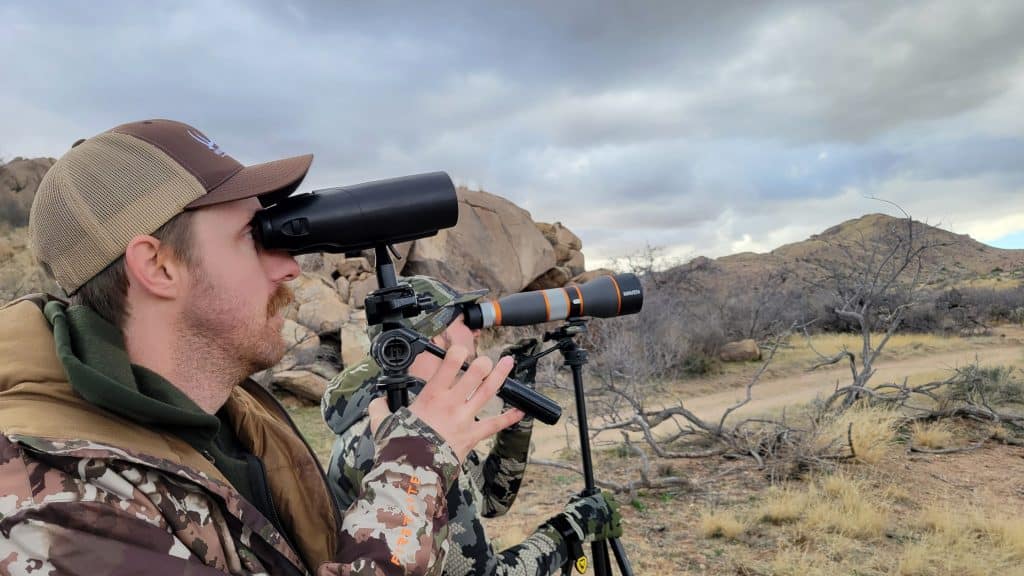
There’s no replacement for a spotting scope when it comes to scouting and picking apart hillsides. The magnification advantage over binoculars is enormous at distance.
I use binoculars walking into my hunting areas through thick foliage so I don’t push animals out ahead of me. The spotting scope comes out for glassing ridges and far-off hillsides — far enough away that I can set up without spooking anything.
A tree stand hunter probably doesn’t need a spotter. Anyone scouting or patterning animals at distance does. Target shooters need one to see hits without walking downrange, unless you’re running 15x binos on a tripod.
How To Choose The Best Spotting Scope
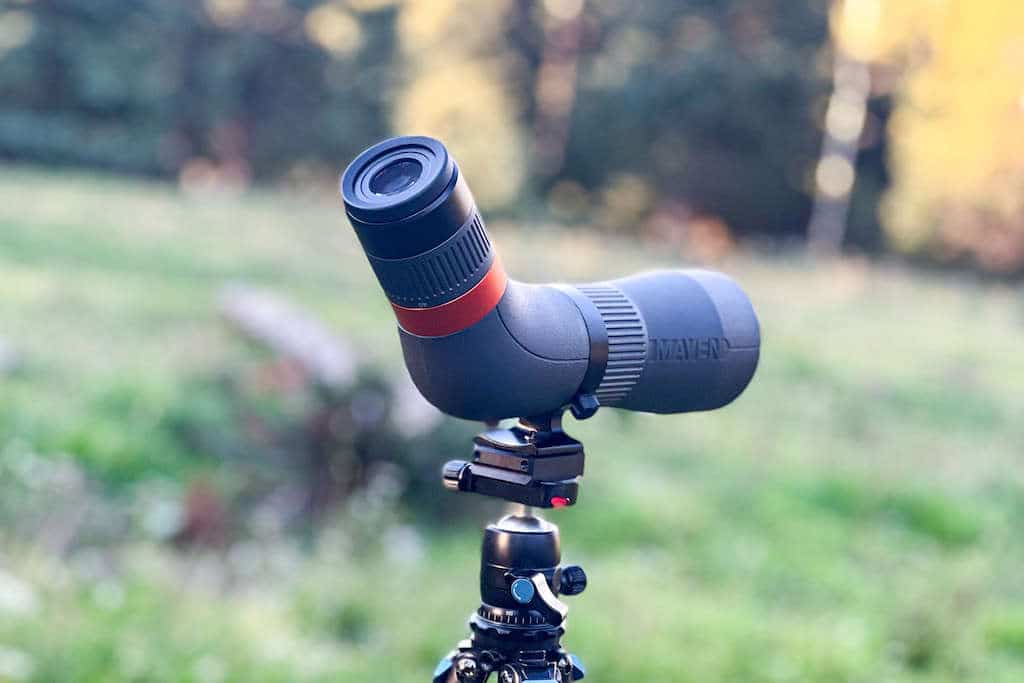
Magnification Range
Take a 20-60×80 scope. The first number (20) is minimum magnification, the second (60) is maximum, and the last (80) is the objective lens diameter in millimeters. Bigger objective means more light and more detail.
There’s no one-size-fits-all, but we recommend a minimum of 30x top-end magnification and a 50mm objective. Below that, you might as well carry binoculars. Worth knowing: two scopes both rated 20-60×80 can produce wildly different images — glass quality matters far more than the numbers.
Angled Or Straight Eyepiece
I prefer angled. It’s easier to use seated, works with a shorter tripod, and makes digiscoping with a phone far simpler. Target shooters often prefer straight because they can get on target faster. Both weigh about the same, so it comes down to how you hunt.
Eye Relief
Eye relief is the distance from the lens to your eye that still produces a full, undistorted image. It matters less on spotters than on rifle scopes, but glasses wearers should look for 17mm or more. Every scope on this list clears that bar.
Weight
I count ounces in my pack the way some people count calories. My theory is the lighter the bag, the harder I can push and the farther I can get. That said, most hunters never carry a spotter more than half a mile from the truck — so be realistic about whether weight actually costs you anything.
Price
You get what you pay for with glass. That’s a cliché because it’s true. Buy what you can afford now and upgrade as your budget grows — a $300 scope you own beats a $3,000 scope you’re saving for.
Why Trust Us
Josh Riley guides elk, deer, moose, and bear hunts in Colorado’s Rocky Mountains 50-plus days a season. Spotting scopes aren’t a hypothetical for us — glassing is how we find animals for clients, and bad glass costs opportunities. Every field photo on this page is our own, shot on our own hunts with our own glass.
Final Stalk is also an authorized dealer for Leupold, Athlon, Konus, Bushnell, Sig, and more. We stock over 20 spotting scopes, which means we handle this glass, mount it, and hear from customers about what holds up.
Straight talk: we haven’t personally hunted behind every scope on this list. The ones we own or have used in the field are marked with a From the field note — the SX-4 Pro Guide, Viper HD, Diamondback, Maven CS.1, plus the Bushnell Trophy Xtreme and Vortex tripod. For the rest, we’ve verified specs against manufacturer data, checked prices in July 2026, and cited independent testing from Field & Stream’s optics team and GOHUNT where their hands-on results are stronger than our own.
We also flag real cons on every pick, including on scopes we sell. If glass is heavy, soft at high magnification, or discontinued, you’ll read it here.
Frequently Asked Questions
What is the best spotting scope for hunting in 2026?
The Leupold SX-4 Pro Guide HD Gen 2. It delivers premium low-light performance and American-built durability at $1,199.99 — roughly a third of what alpine glass costs, with a lifetime warranty behind it. I’ve glassed elk with it many times and the sight picture stays crystal clear across the magnification range.
What is the best spotting scope for the money?
The Vortex Viper HD at $699. It performs close to glass costing two to three times more, and Vortex’s unconditional VIP warranty means a broken scope gets replaced without an argument.
How much magnification do I need in a spotting scope?
At least 30x at the top end with a 50mm or larger objective. Magnification matters more for target shooting — picking out dime-sized holes at 100 yards is harder than spotting a bull elk at 1,000.
Is an angled or straight spotting scope better?
Angled is better for seated glassing, shorter tripods, and digiscoping. Straight gets you on target faster, which is why many target shooters prefer it. Weight is comparable either way.
Do I need a spotting scope if I already have binoculars?
If you hunt from a tree stand, probably not. If you scout, pattern animals at distance, or hunt open Western country, a spotter shows you detail binoculars simply can’t resolve — like whether that bull is worth a two-mile stalk.
What is digiscoping?
Mounting a phone or camera to your spotting scope to photograph or film what you’re watching. It’s easier with an angled eyepiece, and it needs a proper adapter — cheap clips fail, usually at the worst moment.
Which Spotting Scope Will You Carry This Season?

Whatever your budget, there’s a spotting scope above built for how you hunt — from $59.99 starter glass up to $3,199 alpine optics. We stock the Leupold, Konus, Athlon, Bushnell, and Sig picks and ship them straight from the Final Stalk shop.
While you’re gearing up, don’t overlook the rest of the glassing kit: a solid hunting rangefinder, a good pair of binoculars, and boots that get you to the glassing knob.
Think We Ranked These Wrong? Say So.
Optics arguments are the best kind of argument. Maybe you think Swarovski is worth every penny and we short-changed them. Maybe you’ve glassed ten seasons behind a $300 Konus and never felt limited. Maybe you’ll die on the hill that straight eyepieces beat angled.
Make your case. Drop a comment below with what you actually glass through and why — or take it to the Final Stalk forum, where the conversation runs all season. This guide gets better every time a hunter tells us we missed something.
Shop All Spotting Scopes At Final Stalk





i thought reading was a waste of time now that i read all, i know better…thanks for this post
Thanks for checking out the article! Glad it helped.
What is the author’s personal experience with the Diamondback spotting scope from Vortex? How did it perform during their elk hunting expeditions, and what are their recommendations for upgrading to the Viper HD model? At what distance does the Diamondback scope excel in target shooting, and what are the author’s suggestions for longer ranges?
The Diamondback is a rock-solid option for anyone who needs a budget friendly but still capable elk spotter. Lifetime warranty shouldn’t be overlooked when determining real value as well.