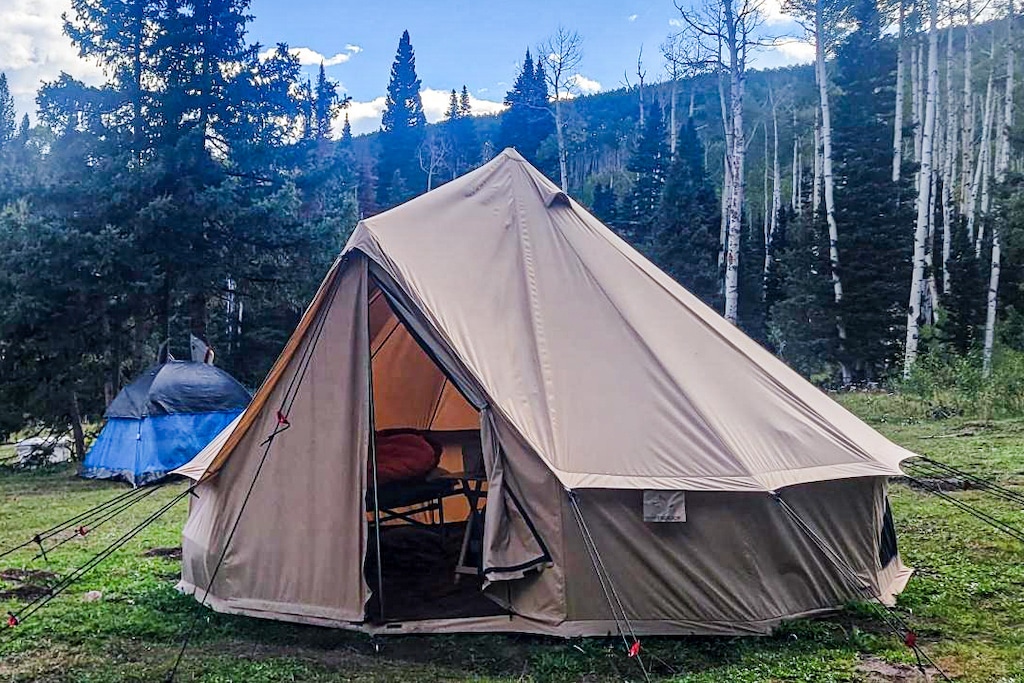
Okay, I’ll admit it: I was a bit overwhelmed this summer when I started to search for my perfect canvas basecamp tent. My month-long Colorado archery elk hunting trip was looming, but my head was spinning all the tent brands and choices I found online.
I knew I had to make the right choice, something guaranteed to shelter me and my gear from Colorado’s unpredictable fall weather. But it also had to do double duty as a comfortable backcountry office while I was there.
Enter the 13’ White Duck Regatta, a proven bell-shaped tent design from a reputable brand. I was impressed with its overall design, materials, and features. It checked all the boxes for us and was used as a cozy hunting base camp and a remote office combo.
If you’re a camper, glamper, or hunter needing a new sturdy canvas tent that won’t let you down, stick around, and I’ll give you a tour of mine.
2025 Update
Well, folks, I originally wrote this review way back in 2022. After three long archery seasons, our 2025 review is the same: the White Duck Regatta bell tent is a worthy addition to any elk base camp.
Here are a few tips to pass on after three seasons of use:
- Be careful with the center pole. It will inevitably try to come out of place and cut a hole in the tent. Keep the protective rubber piece on at all times.
- Keep it out of long-term exposure to the elements. I left it up during two big snow storms, and they knocked it down, resulting in flooding and a little bit of mold on the walls.
- Keep your guy lines tight. The tolerance of the weather flaps is minimal, so you must have all the guylines tight and even.
- Bring along a little carpet in front of the door. This has proven to be a lifesaver for taking off muddy boots.
White Duck Regatta 13’ – Specs & Features
- Living area: ~133 sq. ft.
- Wall Height: 2’ 7”
- Center Height: 8’2”
- Door Height: 6’6”
- Weight: 66 lbs
- Weather Resistance: Four-season
- Stovepipe Exhaust Sleeve: 4-6”
- Colors: Beige, Brown, Olive, Charcoal
- Price: $799 as tested
- Treatment: Water repellent (Optional: Fire + Water Repellent)
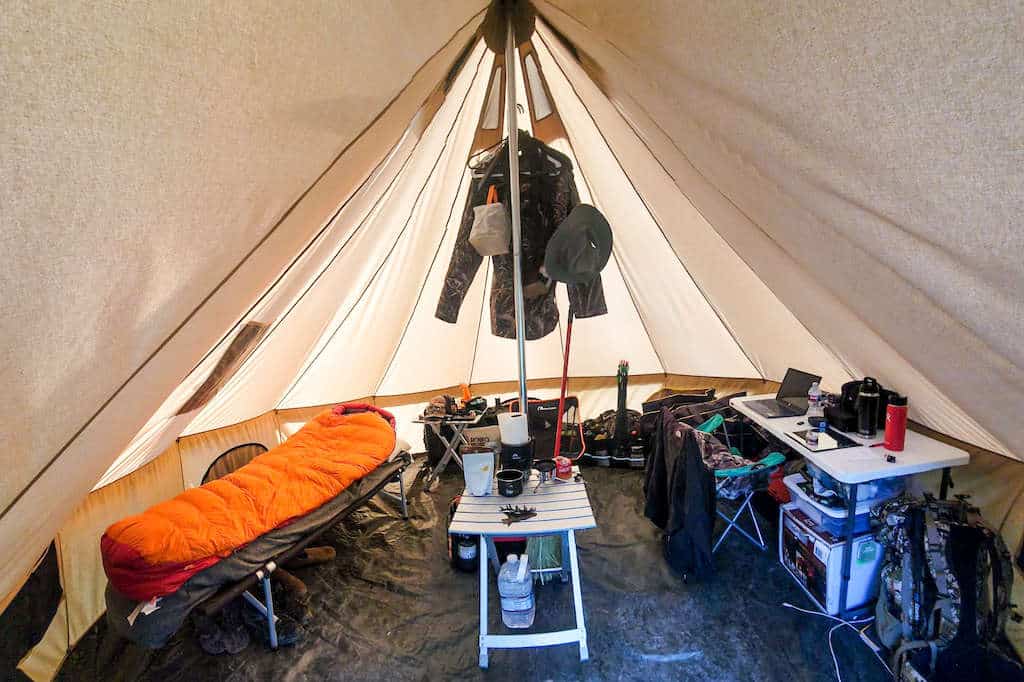
First, the basics: A tent’s sole function is to provide shelter and security for its inhabitants and their gear. In this, the White Duck Regatta scores an immediate bullseye. But it also comes with a home-away-from-home feeling that made my time in the woods much more comfortable than any previous camping trips.
While creature comfort mainly came from all the gear I loaded into the Regatta, its thoughtful features also allowed me to transform it into quite the comfy little cottage. Let’s take a look at what makes it so satisfying:
Ease of Setup
This tent is dead simple to put up. Two of us assembled it in 20 minutes, and I know we could whittle that down further with practice.
We quickly staked out the floor, put up the poles, and staked and tightened the guylines. So that’s it—your empty backcountry canvas lodge awaits you.
As with any tent, plan and factor in exposure and drainage. Rain runoff wasn’t a factor during our stay, but the flat spot we initially chose had too much solar exposure. More on this later.
Size
I chose the medium (13’) version of the Regatta. Inside, I furnished it with a twin-size cot, a table/desk, and all my essential gadgets for a month of hunting and remote work. That still left plenty of spare room. (Consider what inside footprint you’ll need because White Duck also offers smaller and larger versions.)
In the 13’ version, you could try a queen-size mattress (or two) and maybe squeeze in two more cots if you want to get cozy. Luckily, I had the tent all to myself, so it became my roomy pseudo-cabin-in-the-woods with an ample remote office.
My hunting buddies and I used the Regatta as our meeting place, and it was spacious enough for four adults to escape the rain. However, any more than that, and you’ll be crowding each other’s bubbles.
Materials

Its build quality sets White Duck apart from other affordable generic tent brands. The heavy-duty, double-stitched cotton canvas took a moderate month-long beating in September but revealed no manufacturing defects.
The tent’s three windows have mesh screens to keep the bugs and other pests. At least, that’s the theory. In practice, however, the mesh screens were breached by mice on a midnight mission to raid my granola bars.
They chewed a hole through the mesh windows to nibble on my stockpile of snacks. It was A bummer, but it was my fault for leaving food out.
Storage
The 13’ Regatta has two sets of three pockets, one on each side of the entrance. These are standard mesh tent pockets you can fill with towels, toiletries, and other small trinkets—everything else you’ll need to store elsewhere.
I stored most of my belongings in totes and on tables, but clothing was more of a challenge. I stuffed them in my duffle bag this year, but I think a small clothing rack would fit nicely in the corner of the Regatta next year.
Zippers

Nothing drives me so crazy as cheap zippers on tents. Have you ever stumbled back to your tent in the dark after a refreshing midnight pee, only to be locked out by a stuck tent flap zipper?
I had no such problems with the Regatta. Their tent flaps use beefy and reliable YKK zippers that don’t snag or grab. That’s midnight peace of mind.
Stakes/Guylines
The tent comes with a durable carrying case and a set-up kit. Inside the kit is a mallet and a bundle of half-inch rebar stakes for keeping the tent floor taut and crease-free.
Reflective guy lines held the tent walls in place, and the substantial guyline stakes stayed solidly in the ground for the entire month.
As tents settle and stretch, you may need to tighten the guylines to keep the walls taut. On the White Duck 13’, this is an effortless adjustment using small, no-slip buckles. Easy-peasy.
Electric Cord Access
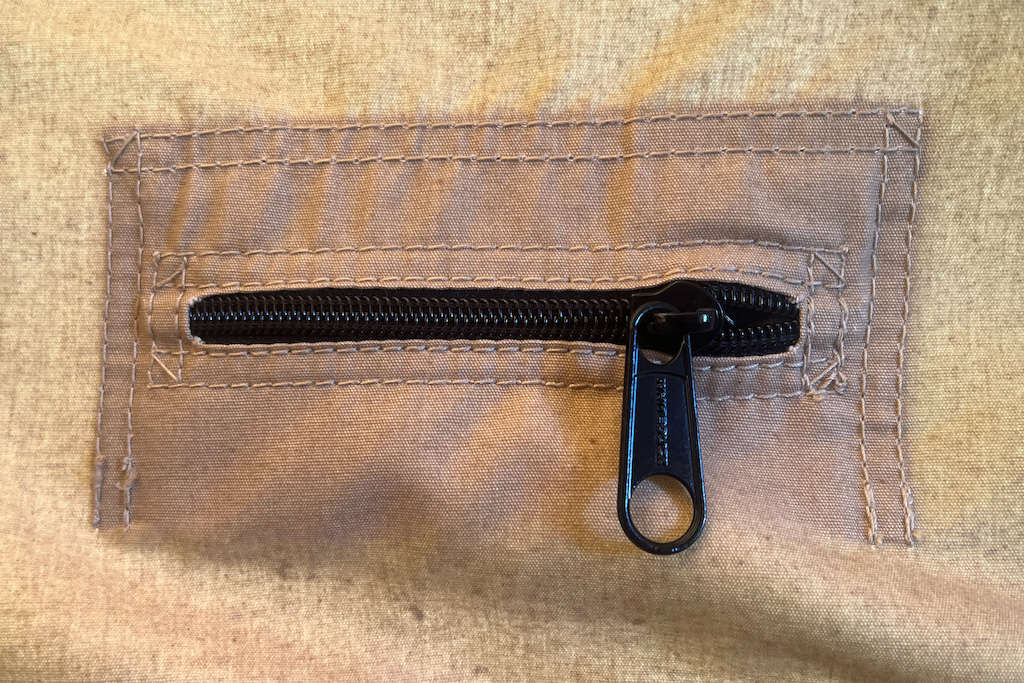
There’s a small zipper on one side of the tent for running electrical cords into and out of the tent, which is surprisingly convenient. However, I’d like the feature even more if there was electrical access on both sides of the tent or via an access hole in the middle.
Multiple cord access points would be more helpful, especially if you dream of adding power lines from your portable solar panels. Ah, the rugged life of modern camping!
Floor/Ground Sheet
A sewn-in polyethylene groundsheet makes the floor watertight and keeps insects and other pests out. In the past, I’ve used canvas tents that lacked floors, and they always turned into muddy nightmares when things got wet. I much prefer a sewn-in floor.
Poles & Hardware
This tent only needs two poles: a small one for the entrance and a bigger one for the center peak. Both poles are made from heavy-duty galvanized steel and didn’t budge during the several windy days of our month-long stay.
Comfort & Temperature Control

The Regatta has a stove jack/sleeve that lets you use a wood-burning stove inside. Or an air conditioner, as you’ll read in a later section. Fortunately, we didn’t need either as the temperate September climate in Colorado gave us mostly perfect weather.
It did get a bit chilly at night, however. In the mornings, I used a propane Buddy heater, which heated the tent in just a few minutes. However, this tiny heater often made it too hot in the tent. Heavy-duty cotton canvas is good at trapping heat.
Remember how I mentioned “too much solar exposure” earlier? Well, our initial choice of pitching the tent in direct sunlight was a mistake because the inside temperature skyrocketed on hot days, making mid-day naps unbearable. We quickly moved the tent into some nearby shade.
Hot scenarios like the above are precisely why you might bring an air conditioner along in the summer and vent it through the stove jack hole. Opening the windows and entrance flap helps, but sometimes it’s better to find deep shade. Which I’ll be sure to do next fall.
Who Would Find This Tent Useful?
- Families that camp regularly
- Glampers and Airbnb hosts
- Remote workers wanting to go off-grid
- Hunters
- Festival Goers
- Wedding Party Tent
Who Wouldn’t Find This Tent Useful?
- Short-stay or overnight campers
- Wilderness or dispersed campers who need a lightweight solution
Is the White Duck Regatta Worth the Money?
My favorite part of the Regatta is its affordable price tag. The 13’ version sells for $800, a bit more expensive than other low-end basecamp tents on Amazon. But judging from buyer comments, those other brands don’t seem to offer quite as good a mix of features and durability.
Don’t Sleep on the White Duck Regatta

My month spent hunting this year was quite satisfying, even though I didn’t harvest an elk. Most importantly, I could do what I love—spending time in the wilderness.
This year, I had the right equipment and could focus on the hunt without fuss. And after a day of moving stealthily through the woods, I returned to a secure shelter that made me feel at home.
In the Regatta, I could stretch out, work comfortably on my laptop, and sleep warmly and deeply at night. I knew I had a tent that would keep me snug as a bug regardless of any bad weather swirling outside.
In the market for a new basecamp tent for camping, glamping, or hunting? Then the White Duck Regatta should be on your short list of contenders.









Leave a Reply